
I’m fortunate to have spent a few weeks recently in my “happy place,” St. John in the US Virgin Islands. There, I snorkeled and meandered along the National Park shores, glimpsing a bit of the beauty explored in today’s Perfect Picture Book.
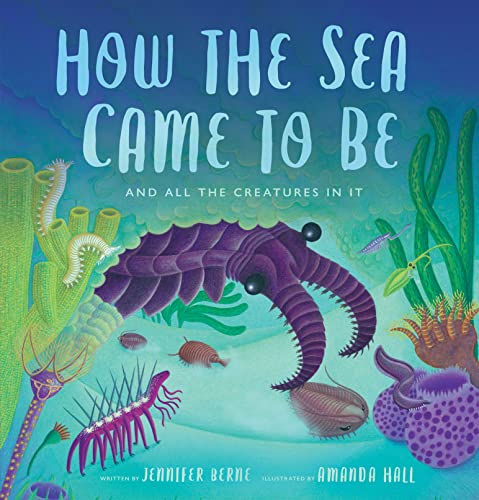
Title: How the Sea Came to Be: And All the Creatures in It
Written By: Jennifer Berne
Illustrated By: Amanda Hall
Publisher/Date: Eerdman’s Books for Young Readers/2023
Suitable for Ages: 6-10 (and younger)
Themes/Topics: poetry, geology, nature, marine biology, non-fiction
Opening:
Part One: The Birth of the Sea
Billions and billions of years long ago,
when the Earth was young and new,
the world was so hot, rock melted and boiled,
and fiery, wild winds blew.
Brief Synopsis: A 4.5 billion year history of the seas and the creatures that have lived and continue to live in them.
Links to Resources:
- Discover 33 ocean-themed experiments, crafts, and activities for kids;
- Try discovering, and explaining, how your home, family, school, or town came to be, and how it has evolved over time;
- Check out the fascinating Back Matter, including Author and Illustrator Notes, descriptions and illustrations of ocean creatures over time, a fold-out illustration and description of the eras of earth history, key terms and concepts, and recommended sources for both children and educators.
Why I Like this Book:
With an engaging, child-friendly ABCB rhyme scheme, Berne shares the fascinating 4.5 billion-year history of the seas and its inhabitants. Starting out when the earth was a fiery mass with no water, Berne recounts how rains fell to the earth as it cooled, creating oceans “all over the world.” From there, she shows how the “teeniest, tiniest stirrings of life” multiplied in the oceans and how they evolved into more complex life forms, including jellyfish, worms, and creatures with “the very first feet.”
In the final third of How the Seas Came to Be, Berne explores the seas from the surface warmed by the sun to the far depths, showing eager readers the fascinating creatures that dwell in each ecosystem.
Berne’s detailed descriptions combined with Hall’s luminous illustrations of these creatures are a true treat for lovers of oceans and the life that inhabits them. Particularly stunning are the spreads showing creatures inhabiting the darkest depths set against a black background and a scene filled with reef dwellers in their bright, multi-colored finery. In her Illustrator’s Note, Hall shares her life-long fascination with natural history and informs readers that multiple trips to the Natural History Museum in London and the Sedgwick Museum of Earth Sciences in Cambridge, England, informed her illustrations, which were vetted for accuracy by the Principal Researcher at the Natural History Museum.
Informative Back Matter completes this stunning picture book. How the Seas Came to Be should be in every elementary school classroom and library, and it’s also a welcome addition to home bookshelves. Note that the recommended age range is a bit older than the average picture book, however, I think the rhyming text and detailed illustrations will draw in younger sea lovers, too.
A Note about Craft:
Berne tackles 4.5 billion years of history in one picture book. Not a small undertaking by any stretch of the imagination! I think it helps that she divides the text into three distinct sections, arranged in chronological order. And while the first two sections follow a timeline, the third, in which she explores current sea creatures, divides them by layers of habitat, from the deepest depths of the ocean to those creatures nearer the surface with which humans are most familiar. That the story ends on a beach with children present shows, I think, that we, the readers and all humans, are connected to “the first life [that] came to be in the sea.”
This Perfect Picture Book entry is being added to Susanna Hill’s Perfect Picture Book list. Check out the other great picture books featured there!




 Wander, Ponder, Write
Sounds like a very interesting book. Put it on hold. Thanks for highlighting it.
LikeLiked by 1 person
I’m surprised you haven’t read or reviewed this one yet. I look forward to learning what you think of it once your copy is available.
LikeLike
Wow! This sounds ambitious and lyrical. I’ll have to check it out. Thanks, Patricia!
LikeLiked by 1 person
I think this is one you’ll really enjoy. Jennifer has made the science accessible to a young audience with poetry. And like A River of Dust, How the Sea Came to Be shows how we’re all connected.
LikeLiked by 1 person
This is a great connection to fossil fuels. I will definitely recommend it to my library.
I love the colors on the cover. Very provocative.
Robin
LikeLiked by 1 person